


My favourites
Easily save and review your favourite models and offers so you don't lose track of them.
 5'
5'
On 12 August 2026, the sky will put on one of the most extraordinary natural spectacles of recent decades. Millions of people will turn their eyes towards the Sun to witness an eclipse visible across much of Spain, an event set to become one of the most memorable astronomical phenomena of recent years.
Beaches, viewpoints and open spaces will bring together thousands of spectators with the same purpose: to witness a phenomenon that only occurs when the Sun, Moon and Earth align in almost perfect harmony.
Yet there is another way to experience this extraordinary moment.
From the sea.
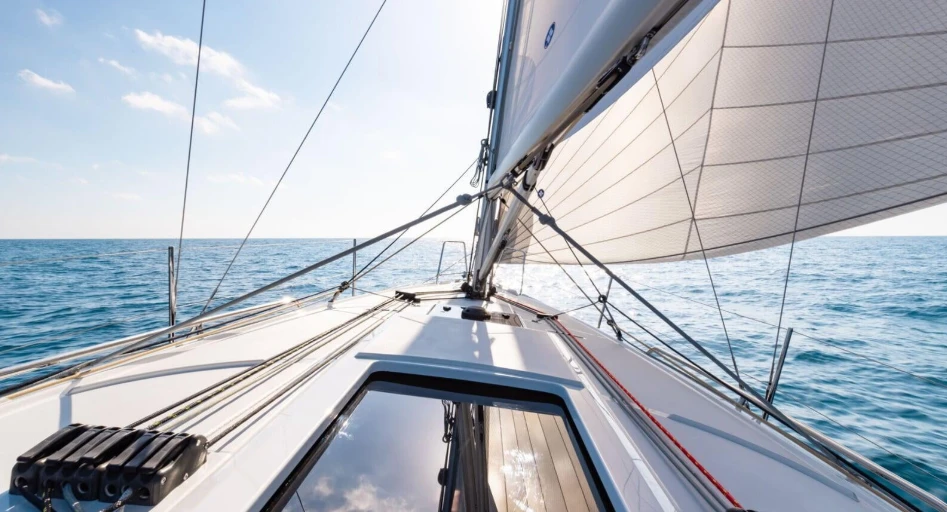
Far from the crowds, with an uninterrupted horizon and surrounded only by the Mediterranean, the eclipse takes on an entirely different dimension. It is not simply about watching the Moon gradually cover the Sun, but about experiencing the changing light, the shifting colours of the sea, the atmosphere and the remarkable silence that settles over the surroundings for a few unforgettable minutes.
Because some experiences are not simply observed. They are lived.
A solar eclipse occurs when the Moon passes between the Earth and the Sun, casting its shadow over part of the Earth's surface.
During this phenomenon, the Moon partially or completely obscures the Sun, causing a gradual reduction in daylight and a remarkable transformation of the surrounding landscape.
In locations where the eclipse is total, observers will be able to witness the solar corona for a few brief moments—the outermost layer of the Sun's atmosphere. This extraordinary phenomenon can only be seen when the Moon completely blocks the Sun's intense light.
Although it lasts only a few minutes, the experience remains in the memory for far longer.
Not all solar eclipses are equally significant.
The one taking place on 12 August 2026 is particularly eagerly awaited, as it will offer the opportunity to witness an exceptional astronomical event without leaving Spain. It will also form part of a rare series of eclipses visible from the Iberian Peninsula over the coming years, an unusual occurrence from an astronomical perspective.
During the eclipse, it is not only the appearance of the Sun that changes. The entire environment is transformed.
The intensity of the light gradually fades, shadows take on striking new shapes, temperatures may fall by a few degrees, and many birds alter their behaviour as they interpret the darkness as the arrival of dusk.
It is precisely this transformation of the landscape that makes the eclipse such an extraordinary experience.
The sea has always been a privileged place from which to admire the horizon.
With no buildings, no visual obstructions and an almost endless panoramic view, it allows you to follow the eclipse from beginning to end with a sense of openness that is difficult to find on land.
But there is something that goes far beyond the view itself.
Anyone who has experienced a sunrise, a sunset or a star-filled night while sailing knows that the sea has a unique ability to transform any natural phenomenon into a far more immersive experience.
During a solar eclipse, that feeling becomes even more intense.
The Sun's reflection on the water gradually fades away, the Mediterranean changes colour, the light takes on an entirely different character and the silence seems even more profound.
There is no traffic, no buildings and no distractions. Just the sound of the sea and an astronomical phenomenon unfolding across a completely open horizon.
It is a truly unique way to experience the eclipse from a privileged perspective, deeply connected with nature.
Although it is an exciting event, safety should always come first.
Looking directly at the Sun without proper eye protection can cause irreversible eye damage, even during a partial eclipse.
For this reason, the leading scientific organisations recommend following a few simple guidelines:
Only during the phase of totality—when the Sun is completely obscured by the Moon—is it safe to remove your eclipse glasses briefly to observe the solar corona. As soon as the first rays of sunlight reappear, the glasses must be put back on immediately.
Capturing a solar eclipse requires more than simply taking your phone out of your pocket.
Camera and smartphone sensors can be permanently damaged if they are pointed directly at the Sun without adequate protection. For this reason, it is essential to use dedicated solar filters for your photographic equipment and to prepare all your settings before the eclipse begins.
Some practical tips include:
Perhaps the most important piece of advice, however, is also the simplest.
Don't experience the entire eclipse through a screen.
There will be thousands of spectacular photographs taken by professionals. What no image can replace, however, is the emotion of witnessing the phenomenon with your own eyes—always properly protected.
If you are planning to experience the eclipse while under way or at anchor, it is worth preparing for the day in advance.
Before setting off, check the weather forecast and sea conditions to ensure a safe trip. Bring certified eclipse glasses for everyone on board and make sure you have plenty of drinking water, sun protection and all the mandatory safety equipment.
If you intend to stop the boat to watch the eclipse, choose a safe anchorage where you can anchor without interfering with other vessels, and avoid any distractions while carrying out manoeuvres.
If you would like to take photographs, prepare your equipment before the eclipse begins so that you can fully enjoy the experience without rushing.
The best plan is always the one that allows you to forget about the logistics and simply enjoy the spectacle.
Sailing means discovering the sea from a different perspective. Every voyage offers unique landscapes, emotions and unforgettable moments that make each trip a truly special experience.
A solar eclipse belongs to that rare category of events that stay with you for a lifetime.
Watching the sky change colour, seeing the light gradually fade across the Mediterranean, and experiencing the almost complete silence that settles over the surroundings as the Moon covers the Sun is an experience that goes far beyond simply observing the phenomenon.
At Hermanos Guasch, we believe that boating is not only about reaching a destination, but about enjoying the journey and embracing everything the sea has to offer.
And there are few occasions as extraordinary as witnessing one of nature's greatest spectacles from a place where the horizon seems to stretch endlessly.
VIP access
to the world of boating
Subscribe and be the first to hear about offers, sea trials and exclusive events. Useful, straightforward content for discerning sailors.
No spam. Unsubscribe anytime.